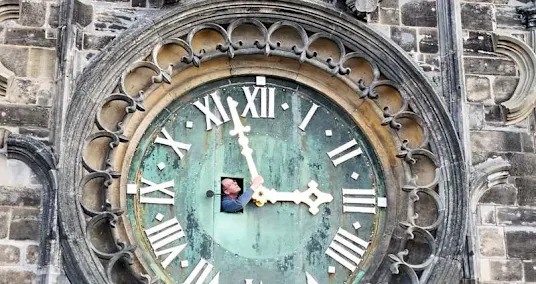
Clocks across the majority of European countries are set to go forward by one hour early on Sunday as the continent moves to daylight saving time, also known as summer time.
Clocks in most European nations including Germany advance by one hour at 2 am (0100 GMT) to 3 am, heralding longer evenings and brighter days.
This means that for the coming months parts of Europe will be on Central European Summer Time (CEST), before moving back to Central European Time (CET) in the autumn, when clocks go back again by an hour on October 25.
The aim of the change is to make better use of daylight in the shorter days of the winter in the northern hemisphere.
The signal for the automatic changeover of the clocks in Germany comes from the Federal Institute of Physics and Metrology (PTB) in the northern city of Braunschweig, also known as Brunswick in English.
The institute's experts ensure that radio-controlled clocks, station clocks and many industrial clocks are supplied with the signal via a long-wave transmitter called DCF77 in Mainflingen near Frankfurt.
LATEST POSTS
- 1
 Extraordinary Picks for Home Apparatuses: Making Life Simpler
 - 2Iran begins cloud seeding to induce rain amid historic drought
- 3Merck sees over $5 billion opportunity in Cidara's experimental flu drug
- 4Which Switch Game Do You Suggest? Share Your Decision
- 5'Heated Rivalry's Ilya Rozanov is now a queer icon in Russia



- Geminid meteor shower 2025 peaks next week. Here's what you need to know about this year's best meteor shower
- 74 suicide warnings and 243 mentions of hanging: What ChatGPT said to a suicidal teen
- Huge solar flare no threat to Artemis 2 astronaut launch to the moon, NASA says
- This St Nick Truly Can Advise How To Drink And Hack Your Headache
- Savvy Tips for Seniors Hyundai IONIQ EV
- Noctourism: the new safari travel trend that's changing the wildlife we can photograph in Africa
- Some Americans say they'll go without health insurance as ACA rates spike
- Artemis 2 astronauts are about to see one of the rarest skywatching sights of all — a solar eclipse from beyond the moon
- Greenland’s melting ice and landslide-prone fjords make the oil and minerals Trump is eyeing dangerous to extract