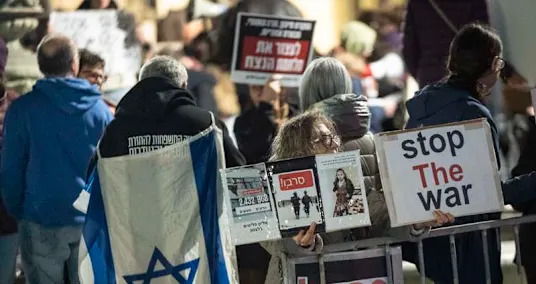
Demonstrators carried signs reading “We must stop” and “Bibi will kill us all,” while about 200 people gathered at Horev Junction in Haifa.
Anti-war demonstrations were held across Israel on Saturday evening, with protesters gathering in Tel Aviv, Haifa, Jerusalem, and Kfar Saba despite strict wartime restrictions on public assembly.
Demonstrators carried signs reading “We must stop” and “Bibi will kill us all,” while about 200 people gathered at Horev Junction in Haifa.
Earlier on Saturday, the Home Front Command granted an exceptional permit for a protest of up to 150 people at Habima Square in Tel Aviv, after state authorities told the High Court of Justice that demonstrations would be allowed only in a limited format and under tight attendance caps.
The Association for Civil Rights in Israel sought an urgent hearing, arguing that the restrictions harm the right to protest.

Security restrictions and court dispute
One IDF officer said the Home Front Command examined each requested protest site individually on operational, professional, and security grounds, including proximity to protected spaces. As a result, authorities did not approve a large gathering at Habima Square and instead allowed only 50 to 150 participants near a shelter.
The officer said the military declined to provide further details on all of its security considerations, but offered to present them to the court in a closed session.
“We are acting professionally and objectively. There is no political consideration here or any other consideration,” he said.
The requests covered several locations, including Habima Square in Tel Aviv, Horev Center in Haifa, Paris Square in Jerusalem, and Weizmann Street in Kfar Saba. In Tel Aviv, the state told the Supreme Court that the protest could proceed in two separate groups of up to 75 people each, for a total of 150 participants.
Protest groups push back
Police and the Home Front Command said the limits stemmed from operational and security concerns, against the backdrop of fears of missile fire and broader wartime restrictions on gatherings.
Civil rights lawyers, however, argued in court that earlier judicial remarks on the importance of political free expression during wartime had not been meaningfully implemented.
The dispute followed a tense High Court hearing on Friday, during which Supreme Court President Isaac Amit sharply criticized the state’s position.
The judges stressed that the right to protest does not disappear during war and said police should propose a framework that would allow demonstrations to proceed.
LATEST POSTS
- 1
 Dental Embed Developments: Upsetting Current Dentistry
 - 2Colombia's military rescues 6 siblings who hid in the rainforest to escape from a rebel group
- 3Who is behind Al-Majd, the Israeli-linked evacuation group sending Gazans to South Africa?
- 4Make your choice for the music application with the most amicable connection point!
- 5A Pompeii site reveals the recipe for Roman concrete. It contradicts a famous architect’s writings


- The Most Moving TED Talks You Want to Watch
- 'Stranger Things' series finale trailer shows Hawkins gang gearing up for last battle with Vecna
- Beyond the habitable zone: Exoplanet atmospheres are the next clue to finding life on planets orbiting distant stars
- A whale stranded at a Baltic Sea resort has swum off a sandbank. But it isn't safe yet
- Step by step instructions to Guarantee Your Lab Precious stone is Morally Obtained
- Instructions to Investigate Different Open Record Extra Offers Actually
- Watch Blue Origin's huge New Glenn rocket ace its epic landing on a ship at sea (video)
- UK clothing inflation climbs as Middle East turmoil threatens wider price rises
- Consumers advised to dispose of 19 cooking pans due to lead leaching risk, FDA reports